A Farmhouse Electric Transport Cart can save time on a working property, but the right choice depends on real daily demands. Picture hauling feed across a damp yard, moving tools between sheds, or carrying harvest crates over uneven ground. In those moments, payload capacity, tire grip, braking, and battery range matter more than a polished product photo.
This 2026 guide compares carts by practical criteria: rated load, runtime under weight, charging time, turning clearance, and service support. It also considers details buyers may overlook, such as whether the bed fits through a narrow gate or the controls remain easy to use with gloves. Small things count.
A reliable, named specialist quotation cannot be verified from the material provided, so this introduction does not invent one. That matters. A false attribution would weaken an equipment comparison that should help readers make informed decisions. Instead, the guide focuses on measurable specifications and clear trade-offs, while recognizing that published range figures may not reflect muddy slopes, cold mornings, or repeated heavy trips. Even good data has limits.
No single cart suits every farmstead. The best option for a compact garden may feel underpowered on a large acreage, while a high-capacity model may be awkward in tight spaces. This comparison aims to identify the strongest fits, explain the compromises, and help readers choose a Farmhouse Electric Transport Cart for the work they actually do.
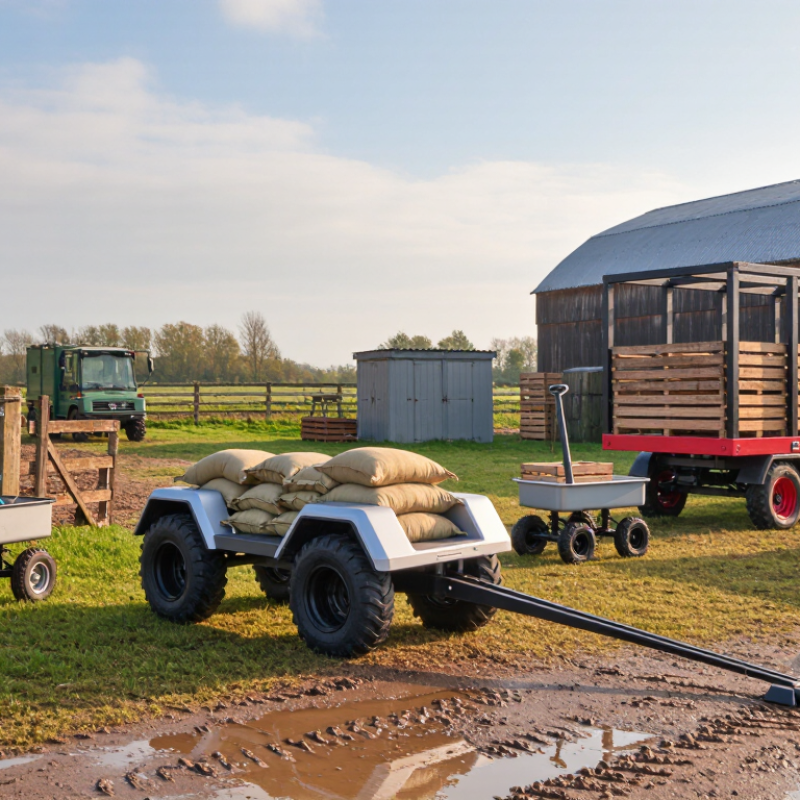
A farmhouse electric transport cart is a battery-powered utility vehicle built to move supplies around a farm or rural property. It may carry feed bags, fencing tools, harvested vegetables, or a water container between buildings and fields. Unlike a passenger-focused cart, its design usually prioritizes a cargo bed, useful ground clearance, and steady movement at low speeds. The exact meaning of “farmhouse” varies; it is not a universal technical category.
Most models use rechargeable batteries and an electric motor, with controls for forward travel, reverse, and braking. A small cargo bed can be handy near a barn, but capacity matters. Check the rated payload, tire type, braking system, and expected travel distance before choosing a cart. A full load of feed feels very different from an empty ride on level ground. Not a minor detail.
Terrain should guide the decision. Firm lanes and gentle slopes suit many carts, while deep mud, loose gravel, and steep inclines can reduce traction or range. Measure narrow gates and shed entrances, too. A cart that cannot turn beside a feed room may be frustrating, even if its battery lasts all day. Charging access and simple routine checks matter as well. Electric operation is quieter than many fuel-powered alternatives, but quiet does not mean maintenance-free. Tires, brakes, battery condition, and load balance still deserve attention.
A useful farmhouse electric transport cart should match the jobs you repeat, not just the largest load you might carry once. On a typical morning, that could mean moving feed sacks from a shed, hauling tool boxes to a fence line, or carrying harvest crates over uneven ground. Check the rated payload against your heaviest regular load, including the driver and any attachments. Too little capacity strains the cart; too much can make tight barn aisles awkward.
Pay close attention to the ground it must cross. Packed gravel, damp grass, shallow ruts, and gentle slopes need different levels of traction and clearance. Larger tires may roll more steadily over rough patches, while a tight turning radius matters near gates and livestock pens. Reliable brakes are essential on slopes, especially with a full bed. Test the stopping feel with a realistic load, not an empty cart. Small details matter.
Battery range should cover a full work loop with some reserve, since cold weather, hills, and heavy loads can reduce runtime. Consider where the cart will charge and whether its controls are easy to use with gloves. A washable bed helps after muddy or dusty jobs, but exposed electrical parts still need sensible protection. No single setup suits every farm. I would measure the narrowest route and note the roughest surface before choosing; I once underestimated a low shed threshold, and it made an otherwise useful cart frustrating.
What Is the Best Farmhouse Electric Transport Cart in 2026?
A cart’s load rating matters only when it matches the real job. Weigh feed bags, tools, and any hitch load, then leave room below the published limit. Heavy cargo can strain the motor and shorten usable range, especially on slopes. A wide, low load also feels steadier on uneven ground. Check the capacity plate, not a sales estimate.
Range figures are usually measured on firm, level surfaces. Farm lanes rarely cooperate. In its 2019 electric-vehicle test, AAA found that passenger-car range fell by 41% at 20°F when cabin heating was used. That result is not a cart prediction, but it shows how cold can affect batteries. Mud, grass, gravel, and repeated stops add further uncertainty. Cold weather matters. Plan around the hardest route, not the shortest one.
Tires and ground clearance shape performance as much as battery size. USDA Natural Resources Conservation Service guidance notes that soil compaction reduces pore space; wet, soft ground can also demand more effort from a loaded cart. Choose tire tread and clearance for the farm’s actual paths, and test the cart with a realistic load. One detail is easy to overlook: a bigger battery may add weight. I would rather have a modest range estimate tested on a muddy lane than a generous figure from a smooth test track.
| What Is the Best Farmhouse Electric Transport Cart in 2026? — How Do Load Capacity, Range, and Terrain Affect Performance? | |||
|---|---|---|---|
| Decision Factor | Useful Measurement or Example | Effect on Performance | What to Look For |
| Rated payload | Compare the cart’s stated payload rating with the heaviest planned load, including tools, feed, water, and attachments. | More payload increases rolling resistance and the energy required to accelerate, climb, and stop. Exceeding the rating can affect stability, braking, and component life. | Choose a model whose published payload rating exceeds your heaviest routine load. Check whether the rating includes the driver or only cargo. |
| Battery energy | Nominal battery energy is calculated as volts × amp-hours ÷ 1,000. For example, 48 V × 100 Ah = 4.8 kWh nominal. | Battery energy sets the amount of stored energy available, but usable energy is lower than nominal capacity and can vary with battery chemistry, temperature, age, and discharge limits. | Compare battery energy in kWh, not amp-hours alone; amp-hours are meaningful only when voltage is also known. Confirm charging time and battery replacement availability. |
| Estimated range | Illustration only: if a 4.8 kWh battery provides 80% usable energy (3.84 kWh), estimated range is about 19.2 km at 0.20 kWh/km, 12.8 km at 0.30 kWh/km, or 9.6 km at 0.40 kWh/km. | Range falls as energy use per kilometre rises. Payload, speed, stop-start work, hills, tire pressure, surface condition, and temperature can all change consumption. | Treat these figures as a calculation example, not a product rating. Ask for range under a comparable payload, route, speed, and terrain, and keep a reserve for the return trip. |
| Terrain and traction | Record the route’s surface, steepest gradient, soft or muddy sections, and total elevation gain. Compare 2WD and 4WD configurations where available. | Loose, wet, uneven, or sloped ground can increase wheel slip and rolling resistance. Additional driven wheels may improve traction, but do not guarantee safe operation on every slope. | Match drive type, tires, ground clearance, and braking to the farm’s actual routes. Check the manufacturer’s limits for gradients and operation on slopes. |
| Elevation gain | For a combined cart-and-load mass of 1,000 kg, gaining 100 m in elevation requires about 0.27 kWh of gravitational energy before drivetrain losses: m × g × height. | Repeated climbs draw additional battery energy. Descending does not necessarily recover all of that energy; regenerative braking, if fitted, has limits. | For hilly farms, compare routes by elevation as well as distance, and verify whether the cart has suitable hill-climbing and downhill braking specifications. |
| Load placement and stability | Keep heavy cargo low and within the load-bed area specified by the maker; secure it against movement. | A high, uneven, or shifting load raises rollover risk and can affect steering and stopping distance, especially on slopes or uneven ground. | Check the load-bed dimensions, tie-down points, axle limits, and any guidance on side slopes or uneven terrain. |
| Best fit by farm use | Light, short trips: prioritize compact size and maneuverability. Heavy loads or rough routes: prioritize payload margin, traction, tires, ground clearance, and braking. | There is no single best configuration for every farm: a cart optimized for capacity may be larger, while a compact cart may be easier to maneuver in narrow paths. | Choose the cart that meets the heaviest routine load and worst regular route, with a practical range reserve—not simply the model with the largest advertised capacity or range. |
| How to compare fairly | Specifications and test methods vary between manufacturers. Compare published payload, battery energy, range-test conditions, drive type, tire type, braking, and slope limits. The range values above are transparent planning calculations, not market averages or claims for a particular cart. | ||
What Is the Best Farmhouse Electric Transport Cart in 2026?
What Cart Features Matter for Safety and Everyday Use?
A useful farm cart should feel steady on gravel, damp grass, and uneven barn floors. Look for a clearly marked load limit, a low center of gravity, and tires suited to your usual paths. Brakes should hold the cart on a slope, while a guarded emergency stop should be easy to reach. Check that handles and controls remain comfortable when wearing gloves. Small details count.
Everyday usefulness depends on more than battery range. A removable battery can simplify charging, and a visible charge indicator helps prevent mid-job surprises. Check turning clearance near gates and the cart’s width against narrow barn doors. The U.S. Bureau of Labor Statistics reported an 18.6 fatal work-injury rate per 100,000 full-time-equivalent workers in agriculture, forestry, fishing, and hunting in 2022. This figure covers the sector, not carts specifically, but it underscores why stable handling and predictable stopping matter. OSHA’s powered-industrial-truck guidance also emphasizes load limits, stability, and operator training; treat these as useful safety principles, not cart-specific certification. Specs can look reassuring. Real ground can disagree.
Tips: Before buying, test a loaded cart on your steepest regular route. Listen for brake or motor strain, and check whether the load shifts over bumps. I’d also measure the narrowest doorway twice; it’s an easy thing to overlook.
Battery capacity affects how long a cart can run between charges—and how long it may take to recharge. This chart shows calculated ideal charging times for example 48 V battery packs using a 10 A charger.
How to use this: A larger battery can support longer use, but takes longer to charge with the same charger. These times are simple calculations (battery amp-hours divided by charger amps); real charging usually takes longer because of charging losses and the battery’s charging profile. For safe everyday use, also check the cart’s rated payload, service and parking brakes, lights, tires, and stability on the terrain where you’ll drive.
Comparing farmhouse electric transport carts starts with the route, not the advertised top speed. Measure the usual load, steepest slope, narrowest gate, and distance between charging points. Then compare rated payload, braking performance, turning radius, ground clearance, tire type, and battery capacity. Ask whether the payload rating includes the operator or attachments; specification sheets are not always clear.
1.9 million
U.S. farms counted in 2022
The USDA National Agricultural Statistics Service’s 2022 Census of Agriculture counted about 1.9 million U.S. farms across 880 million acres. That scale makes one-size-fits-all advice unreliable. Use the census as context, not a sizing formula: a cart crossing a compact yard has different needs from one moving feed over uneven acreage. Request runtime details under load, and test on the surface you actually use. A flat showroom floor tells you little about wet grass.
Check charger location, battery replacement cost, service access, and whether the cart can be safely parked on a slope. Compare these details alongside purchase price. No spec sheet captures mud. Also, claimed range may not match cold mornings, repeated stops, or heavy loads; leave a practical reserve. A short trial with sacks or tools can reveal awkward steering and poor visibility before those issues become daily frustrations.
Match its rated payload to your heaviest regular load, including the operator and attachments. Too little capacity can strain the cart. Too much may make narrow barn aisles awkward.
Consider your actual routes: gravel, damp grass, shallow ruts, and slopes. Larger tires may feel steadier on rough patches. Mud changes things.
Test the brakes on a slope with a realistic load, not an empty cart. Check that an emergency stop is easy to reach. Test it loaded.
Choose enough range for a full work loop, with some reserve. Cold weather, hills, heavy loads, and frequent stops can reduce runtime. Specs can mislead.
Look for a clear charge indicator, comfortable controls for gloved hands, and a washable bed. Check that exposed electrical parts have sensible protection.
Measure your narrowest doorway, tightest turn, steepest route, and usual distance between charging points. I would measure a low shed threshold twice; it is easy to miss.
Compare payload, braking, turning radius, ground clearance, tire type, and battery capacity. Ask whether the payload rating includes the operator or attachments.
Try it on your own ground with sacks or tool boxes. Notice steering, visibility, braking, and whether the load shifts over bumps. A flat floor tells little.
Choosing the best Farmhouse Electric Transport Cart in 2026 starts with understanding the work it needs to do. These carts can help move feed, tools, harvested produce, and other supplies around a farm, but the right model depends on daily tasks and working conditions. Consider the weight and size of typical loads, how far the cart must travel between charges, and whether routes include slopes, mud, gravel, or uneven ground. A cart’s stated capacity and range are most useful when assessed against real operating conditions rather than in isolation.
Safety and ease of use matter just as much as hauling performance. Look for stable handling, dependable braking, straightforward controls, suitable tires, and practical features such as secure cargo areas and convenient charging. Compare options by matching their capacity, battery range, terrain suitability, construction, and maintenance needs to the farm’s routine. The best choice is a well-balanced cart that can handle regular work reliably without being unnecessarily difficult or costly to operate.