A Hotel Electric Guest Buggy is a practical transport vehicle designed for large hospitality properties. It helps guests move between entrances, rooms, restaurants, parking areas, and recreational facilities. This service becomes especially valuable on expansive resorts, where a short walk may take ten minutes or more.
The experience is simple but meaningful. A guest arriving with two suitcases can receive a quick ride instead of crossing a busy driveway. Families can travel comfortably with children, while older guests may avoid steep paths or long distances. Hotel staff can also use the buggy to support luggage transfers, room inspections, and internal guest services. Quiet electric motors create less noise around pools, gardens, and accommodation buildings.
Still, a buggy is not a complete solution. Its usefulness depends on battery range, seating capacity, weather protection, charging access, and trained operators. A vehicle that looks suitable may struggle on slopes or narrow pathways. That detail is easy to overlook. Hotels should assess traffic routes, pedestrian movement, maintenance records, and guest accessibility needs before choosing a model.
Reliable operations matter as much as the vehicle itself. Clear seating limits, routine inspections, and careful speed control protect passengers and staff. In daily use, the best Hotel Electric Guest Buggy supports comfort without feeling intrusive. It should arrive promptly, operate quietly, and fit naturally into the property’s service standards. That balance explains why many hotels consider electric guest buggies an important part of modern guest transportation.
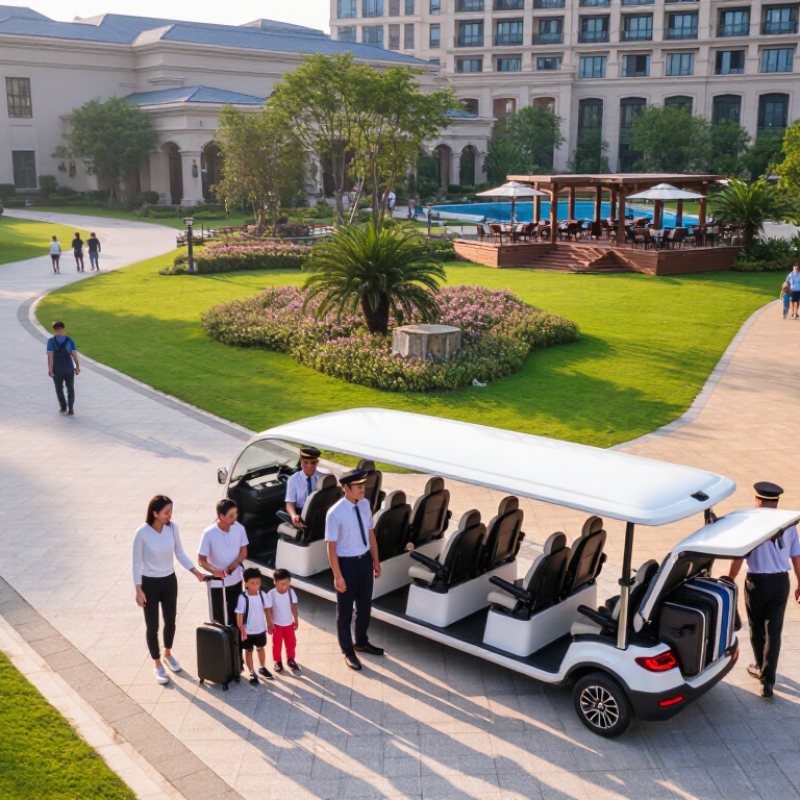
What Is a Hotel Electric Guest Buggy Used For?
A hotel electric guest buggy is a small, battery-powered vehicle for moving guests around large properties. It commonly serves resorts, conference centers, holiday parks, and private estates. Unlike a standard car, it prioritizes short-distance comfort, visibility, and easy boarding. Guests may use it between a lobby, villa, restaurant, pool, or parking area. Staff can also transport luggage, supplies, or visitors with limited mobility.
Its core system includes an electric motor, rechargeable battery, steering controls, seats, and a braking system. Many models provide two to eight passenger seats. A low step helps older guests enter safely. Handrails add support. Some buggies include roofs, windshields, doors, lights, mirrors, seat belts, and rain curtains. These details matter when the vehicle crosses wet paths or operates after sunset. The motor runs quietly, which protects the peaceful atmosphere around guest rooms.
Operational reliability depends on more than battery capacity. Staff should check tire pressure, brakes, charging levels, and visible damage each day. A buggy that looks clean may still need inspection. Charging time can affect busy arrival periods, especially when several trips occur together. Speed control is also important on slopes, narrow lanes, and crowded walkways. One assumption deserves review: electric does not automatically mean risk-free. Clear routes, trained operators, passenger limits, and regular maintenance remain essential. A practical buggy should feel stable, clean, quiet, and predictable during every short journey.
A hotel electric guest buggy is a low-speed, battery-powered vehicle used to transport guests, luggage, and staff across large properties such as resorts, hotels, villas, and conference venues. Its core features typically include quiet operation, zero tailpipe emissions, compact dimensions, and multiple seating layouts.
The chart shows common passenger-capacity configurations found in hotel and resort electric guest buggies. Two- and four-seat models are often used for individual guest transfers, while six-, eight-, and fourteen-seat layouts are suited to group transportation, airport-style transfers, and shuttle services. Actual capacity varies by vehicle design, local regulations, luggage requirements, and operating conditions.
An electric guest buggy moves visitors across large hotel properties. It serves villas, parking areas, beaches, restaurants, and event spaces. Staff may also use it for luggage, maintenance supplies, or accessibility support. The vehicle usually runs through a rechargeable battery, motor controller, and electric drive motor. An onboard charger connects to a designated charging point after each shift.
Operation depends on disciplined dispatching. Staff check battery level, tire condition, brakes, lights, and passenger capacity before departure. A simple radio or digital schedule can prevent duplicate trips. The U.S. Department of Energy reports that electric vehicles convert roughly 77–82% of grid energy into movement. Gasoline vehicles convert about 12–30%. This comparison is not specific to hotel buggies, but it provides a useful efficiency benchmark.
Quiet operation matters.
The International Energy Agency’s Global EV Outlook 2024 recorded more than 14 million electric car sales in 2023. That growth supports wider charging knowledge, yet hotel properties still face practical limits. Long routes, steep paths, heavy luggage, and frequent stops reduce range. A buggy can appear efficient while wasting energy through poor scheduling. Charging equipment also needs weather protection, inspection, and clear access. Operators should record trip distance, charging time, battery condition, and passenger demand. Small records reveal problems. Sometimes, the real issue is not the vehicle, but an unrealistic route plan.
An electric guest buggy moves people efficiently across large hotel grounds. It connects the lobby with villas, pools, restaurants, parking areas, and conference halls. Guests with heavy luggage appreciate the short ride, especially during hot weather or rain. Staff can also use it for linen delivery, room-service support, maintenance tools, and light housekeeping supplies. The International Energy Agency’s Global EV Outlook 2024 recorded nearly 14 million electric car sales in 2023. This growth reflects wider confidence in electric transport. Still, a buggy is not a magic solution. Poor route planning can create delays and unnecessary battery use.
Guest transport remains its clearest role. Drivers can offer scheduled transfers, luggage collection, and accessible rides for guests with limited mobility. On busy arrival days, several small trips may reduce lobby congestion. Booking.com’s 2024 Sustainable Travel Report found that 75% of travelers wanted to travel more sustainably. Quiet electric transport can support that expectation without adding engine noise near guest rooms. However, hotels should measure real usage instead of assuming every route needs a vehicle.
Tips: Map high-demand routes before purchase. Check turning space, ramp access, weather protection, payload limits, and charging time. Train drivers to slow down near pedestrians. Inspect brakes, tires, lights, and seat belts daily. Keep a manual backup plan; batteries can fail at inconvenient moments.
An electric guest buggy moves guests between reception, villas, parking areas, restaurants, and event spaces. It reduces long walks across large properties. It also supports guests carrying luggage, using mobility aids, or travelling with young children. The World Health Organization’s 2022 Global Report on Health Equity for Persons with Disabilities estimates that 1.3 billion people experience significant disability worldwide. That figure makes accessible transport a service requirement, not merely a luxury. Still, a buggy cannot replace thoughtful pathways, ramps, clear signs, or trained staff.
Safety begins with controlled speed, visible lighting, working brakes, and daily inspections. The WHO’s Global Status Report on Road Safety 2023 reports approximately 1.19 million road deaths each year. Hotel routes are quieter, but pedestrians, bicycles, luggage carts, and service vehicles still create collision risks. Drivers should slow near crossings and announce stops clearly. Seat belts matter. So does stable boarding.
Passenger comfort depends on more than soft seats. A low step, firm handrail, weather protection, and smooth acceleration reduce strain. Shock absorption helps on uneven paving. Ventilation matters during humid transfers. The buggy should leave enough room for mobility devices without forcing awkward movements. Operators may overlook small details, such as glare from overhead lights or rainwater near the step. These weaknesses deserve honest review. A short passenger survey can reveal discomfort that routine inspections miss. Comfort is measurable, but not always obvious.
What Is a Hotel Electric Guest Buggy Used For?
Selecting and Maintaining a Hotel Electric Guest Buggy
A hotel electric guest buggy carries visitors, luggage, and supplies across large properties. It serves villas, golf areas, event spaces, and distant parking zones. Quiet electric drive protects the calm atmosphere around guest rooms. A suitable buggy should match passenger capacity, route length, terrain, and daily traffic. Measure slopes and turning areas before choosing. A four-seat model may suit short transfers, while heavier luggage requires stronger suspension and braking. Check the battery type, charging time, weather protection, and safety equipment. Do not select by appearance alone. Shiny panels cannot compensate for weak brakes.
Maintenance begins with a simple daily inspection. Staff should test steering, brakes, lights, horn, tires, seat belts, and reverse alarms before service. Look for loose terminals or damaged cables. Keep charging spaces dry, ventilated, and separated from guest paths. Follow the battery maker’s charging instructions. Overcharging is a common shortcut, and it can shorten battery life. Clean mud from the wheels and underbody after rainy shifts. Record mileage, faults, charging behavior, and completed repairs. These notes help technicians find gradual problems.
Training also matters. Drivers need clear routes, low-speed rules, and passenger-loading guidance. A buggy can feel harmless, but wet paving changes stopping distance. Supervisors should review incidents without hiding uncomfortable details. Our judgment can be wrong when a vehicle seems reliable. Replace worn parts through qualified technicians, and schedule professional inspections at practical intervals.
| Data Dimension | Typical Specification or Practice | How It Supports Hotel Operations | Selection or Maintenance Consideration |
|---|---|---|---|
| Primary Purpose | Guest transportation across large or spread-out properties | Moves guests between the lobby, rooms, restaurants, pools, parking areas, event spaces, and other facilities. | Choose a configuration that matches the property layout, guest volume, terrain, and expected travel distances. |
| Common Secondary Uses | Luggage transfer, accessibility support, event transport, and internal service movement | One vehicle can support front-desk requests, group arrivals, wedding events, and mobility assistance. | Confirm that the seating and cargo arrangement can handle the required combination of passengers and luggage. |
| Passenger Capacity | Typically 4 to 14 passengers, depending on the vehicle layout | Smaller buggies suit routine guest transfers, while larger models support groups and peak check-in periods. | Avoid routinely exceeding the rated passenger capacity because overloading affects braking, stability, range, and component life. |
| Cargo Capacity | Commonly includes a rear platform, front compartment, or dedicated luggage area | Provides practical space for suitcases, parcels, housekeeping supplies, or event materials. | Check the permitted cargo weight and secure loose items to prevent shifting during turns or braking. |
| Typical Operating Speed | Often limited to approximately 15–25 km/h (9–16 mph) | A moderate speed supports controlled movement in pedestrian areas and shared hotel driveways. | Set the speed according to local regulations, traffic conditions, visibility, pedestrian density, and property policy. |
| Driving Range | Approximately 50–100 km per charge under moderate operating conditions | Allows multiple guest-transfer routes during a working shift without frequent charging interruptions. | Actual range varies with passenger load, hills, temperature, tire pressure, driving habits, and battery condition. |
| Charging Time | Usually about 6–10 hours for a full charge, depending on battery and charger specifications | Overnight charging can prepare the vehicle for the next operating day. | Use the correct charger, keep the charging area ventilated, and follow the battery manufacturer’s charging instructions. |
| Battery Type | Common options include lead-acid and lithium-ion battery systems | The battery system determines charging behavior, vehicle weight, operating cost, and service requirements. | Lead-acid batteries require more routine inspection and careful watering when applicable; lithium-ion systems require compatible charging equipment and battery-management controls. |
| Terrain Capability | Designed for paved roads, internal paths, parking areas, and moderate inclines | Enables convenient transport between buildings that are too far apart for comfortable walking. | Evaluate the maximum gradient, ground clearance, turning radius, drainage, and surface quality before purchase. |
| Passenger Safety Features | Seat belts, handrails, mirrors, headlights, brake lights, indicators, horn, and protective screens where needed | Improves visibility, passenger stability, and driver awareness in busy hotel environments. | Inspect safety equipment before each operating shift and replace damaged or missing components immediately. |
| Daily Inspection | Check battery status, tires, brakes, steering, lights, horn, seats, belts, mirrors, and visible damage | Identifies defects before they affect guests, staff, or vehicle availability. | Use a written checklist and remove the buggy from service if braking, steering, or electrical safety is compromised. |
| Tire Maintenance | Check pressure and tread condition regularly; inspect for cuts, embedded objects, and uneven wear | Correct tire condition supports stable handling, efficient energy use, and shorter stopping distances. | Maintain the pressure recommended for the specific vehicle and load; rotate or replace tires according to wear patterns. |
| Brake and Steering Checks | Inspect before use and arrange a more detailed service inspection at scheduled intervals | Reliable braking and steering are essential when carrying passengers near pedestrians and buildings. | Pay attention to unusual noise, increased stopping distance, steering looseness, vibration, or pulling to one side. |
| Cleaning and Corrosion Control | Clean high-touch surfaces daily and rinse off dirt, salt, mud, and chemical residue as required | Maintains a professional appearance and reduces the spread of contaminants between guest trips. | Avoid directing high-pressure water at electrical connectors, charging ports, motor housings, or control units. |
| Service Frequency | Daily checks, periodic inspections based on use, and an annual comprehensive review at minimum | Regular servicing helps detect wear before it causes downtime or safety incidents. | Increase inspection frequency for high-use fleets, steep routes, harsh weather, frequent heavy loads, or coastal environments. |
| Best Operating Practice | Smooth acceleration, gradual braking, controlled cornering, and adherence to designated routes | Reduces energy consumption, passenger discomfort, tire wear, and mechanical stress. | Train drivers in pedestrian awareness, luggage handling, reversing procedures, charging safety, and emergency reporting. |
It moves guests between lobbies, villas, restaurants, pools, parking areas, and event spaces. Staff may carry luggage or supplies.
Many models hold two to eight passengers. Operators must follow the stated capacity, especially with luggage.
Low steps, handrails, roofs, windshields, doors, lights, mirrors, and seat belts can help. Accessibility still requires careful judgment.
A rechargeable battery powers the electric motor. An onboard charger connects to a designated charging point after use.
They should check the battery, tires, brakes, lights, visible damage, and passenger capacity. A clean vehicle is not necessarily safe.
Slopes, long paths, heavy luggage, frequent stops, and repeated trips consume more energy. Poor scheduling can waste a full charge.
No. Quiet movement may surprise pedestrians near guest rooms or narrow paths. Drivers still need controlled speeds and clear routes.
Staff can use a radio or digital schedule to avoid duplicate trips. Records should include distance, charging time, and demand.
No. Trained operators, passenger limits, daily inspections, and regular maintenance remain necessary. That assumption deserves review.
It should feel stable, clean, quiet, and predictable. Sometimes, the route plan is the real problem.
A Hotel Electric Guest Buggy is a compact, battery-powered vehicle designed to move guests, staff, and light equipment efficiently around hotel properties. With quiet operation, simple controls, rechargeable power, and flexible seating or cargo space, it is well suited to resorts, campuses, parking areas, and other large hospitality environments. The vehicle typically operates along internal roads and designated pathways, helping reduce walking distances while supporting smooth daily transportation.
Hotels use these buggies for guest transfers, luggage assistance, room-service support, maintenance tasks, event logistics, and accessible mobility services. Safe operation depends on trained drivers, controlled speeds, clear routes, regular inspections, and careful passenger loading. Features such as handrails, comfortable seating, weather protection, easy entry, and secure storage can improve both safety and convenience. When selecting a Hotel Electric Guest Buggy, operators should consider passenger capacity, terrain, range, charging requirements, storage needs, and accessibility. Routine battery care, tire checks, brake inspections, cleaning, and scheduled servicing help maintain reliable performance and extend the vehicle’s useful life.